


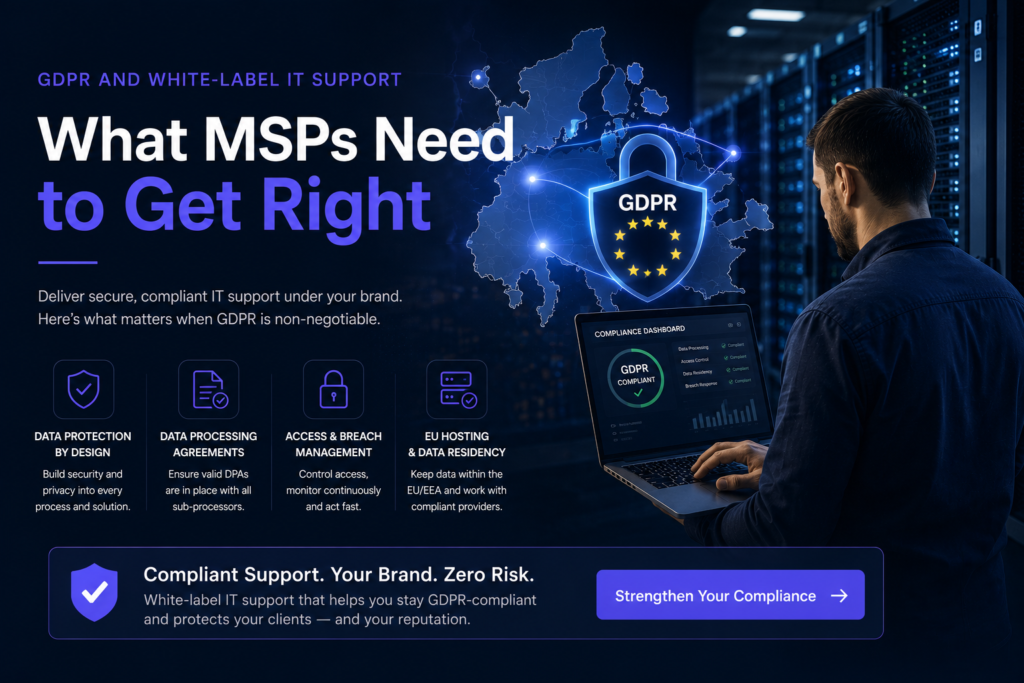
This article provides general, practical background on GDPR considerations relevant to white-label IT delivery. It is not legal advice — MSPs should confirm their specific obligations with a qualified data protection advisor, particularly around Data Processing Agreements with delivery partners.
When a white-label IT delivery partner’s engineers touch your clients’ systems, they’re often processing personal data on your behalf — and, depending on the engagement, on behalf of your end clients too. That chain of responsibility is exactly where GDPR compliance needs to be explicit, not assumed.
Why This Is a Real Issue, Not a Formality
Under GDPR, when a partner processes personal data on your behalf, they’re acting as a “processor,” and you (or your client) remain the “controller” responsible for how that data is handled. If your delivery partner:
- Accesses a client’s servers or workstations
- Views logs, files, or systems containing personal data
- Handles hardware that’s later disposed of or repurposed
…that’s processing activity that needs a proper legal basis and documentation — specifically, a Data Processing Agreement (DPA) between you and the partner, and in some engagements, between the partner and your end client as well.
What to Actually Check With a Delivery Partner
Do they have a standard DPA ready? A partner who’s thought this through has a DPA template ready to execute, rather than needing you to draft one from scratch.
Where is data actually processed and stored? If any part of their operations — ticketing systems, remote access tools, documentation platforms — routes data outside the EU/EEA, that requires additional safeguards (like Standard Contractual Clauses) under GDPR’s international transfer rules.
How do they handle data during onsite visits? Physical access to a workstation or server is still data processing if personal data is on it. Ask how engineers are trained around this, and what’s documented afterward.
What happens to hardware they handle during data erasure or decommissioning? If a delivery partner is involved in retiring old hardware, secure data erasure practices need to be explicit and documented — not just assumed.
Are their own staff bound by confidentiality obligations? A partner’s engineers should be contractually bound to confidentiality and data protection standards consistent with GDPR, not just “trustworthy by reputation.”
Why This Matters More for German Clients Specifically
German businesses tend to have a higher baseline expectation around data protection than many other markets — partly cultural, partly because German data protection authorities (Landesdatenschutzbehörden) are active and specific in their enforcement. A delivery partner who treats GDPR as a genuine operational requirement, rather than a line on a website, is a meaningfully different proposition to a German client than one who doesn’t.
It’s also a real differentiator against non-German-based white-label providers, many of whom are structured around US, UK, or offshore operations where the operational habits around GDPR simply aren’t as deeply built in.
A Practical Starting Point
If you’re evaluating a delivery partner, ask to see (or at least discuss in detail) their standard DPA before you sign a broader agreement. A partner who can produce one immediately, tailored to the type of access their engineers will have, has clearly built this into how they operate — not treated it as an afterthought.
Where AleefTech Fits
AleefTech operates under GDPR-compliant practices as a default, not an add-on — covering onsite data handling, secure data erasure, confidentiality obligations, and Data Processing Agreements structured for each MSP partnership. As a German-led delivery partner, this isn’t a compliance checkbox for us; it’s how the business is actually run.