
An MSP is managing a customer’s server infrastructure from another city. The monitoring system raises an alert, and someone needs to check the physical equipment. Does the MSP need a remote hands engineer to carry out one task, or a datacenter support partner that takes responsibility for ongoing work?
The answer depends on what needs to be done and who is responsible for the infrastructure after the task is complete.
Remote hands is usually the right fit for a clearly defined physical task at a datacenter. Datacenter support is the broader option when an organisation needs ongoing infrastructure assistance, maintenance and incident coordination. The services can overlap, but they are not interchangeable in every situation.
For managed service providers (MSPs), choosing the right arrangement affects how work is assigned, how costs are managed and how technical responsibility is divided between teams.
AleefTechs provides remote hands and datacenter support for MSPs and enterprise IT providers across Germany and the DACH region.
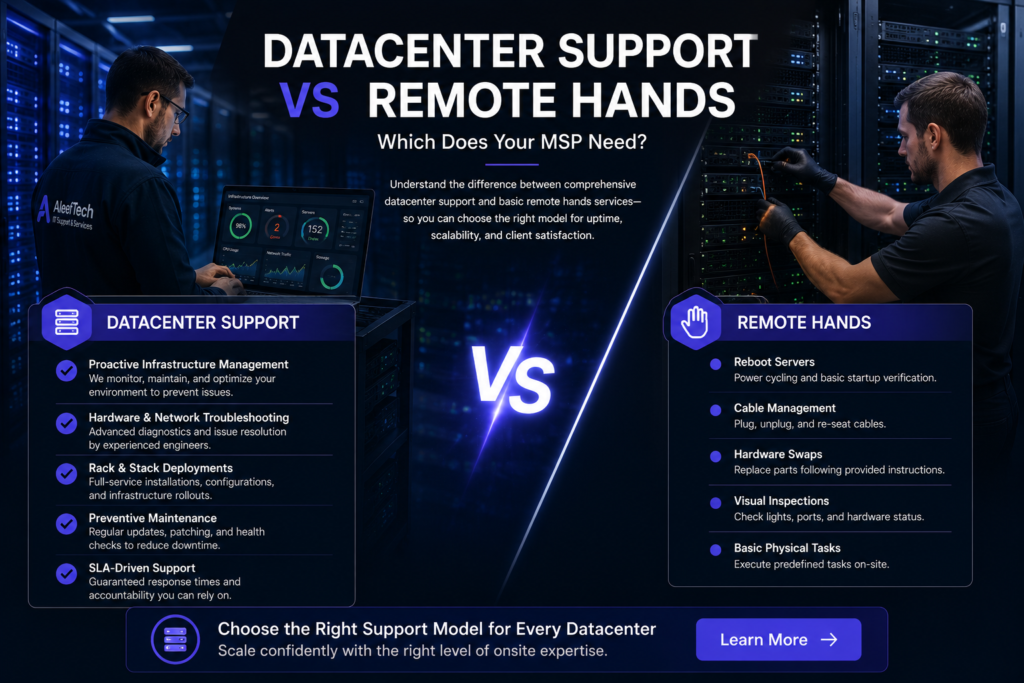
What Is the Difference Between Datacenter Support and Remote Hands?
Remote hands is task-based. An engineer at the facility carries out a specific physical job under instructions from the customer’s IT team.
Datacenter support has a wider scope. Depending on the agreement, it may include recurring infrastructure tasks, hardware maintenance, monitoring, patching coordination and incident response.
| Area | Remote hands | Datacenter support |
|---|---|---|
| Main purpose | Complete a specific physical task | Support infrastructure over time |
| Typical request | Replace a drive, check a cable or photograph a rack | Coordinate recurring infrastructure work and maintenance |
| Work pattern | Usually requested as needed | Can be scheduled or ongoing |
| Monitoring | Not normally included in a standalone task | May be included in the agreed service |
| Responsibility | The customer directs the task and validates the result | Responsibilities depend on the support agreement |
| Pricing | Often per task, visit or hour | May be project-based or covered by an ongoing agreement |
| Best suited to | MSPs that manage systems remotely but need physical access | MSPs that need broader, recurring infrastructure support |
These are common service arrangements, not universal rules. Some providers offer remote hands under a recurring contract, while some datacenter support agreements cover only a defined set of tasks.
Always check the scope, response commitments and exclusions before comparing providers.
1. When Remote Hands Is Enough
Remote hands makes sense when your team already knows what needs to be done and requires someone physically present at the datacenter.
For example, an MSP might need an engineer to:
- Check whether a network cable is connected to the specified port.
- Photograph a server rack or confirm equipment labels.
- Replace a failed drive under the customer’s approved procedure.
- Install a server or network appliance according to an agreed plan.
- Check equipment indicators and report their status.
- Assist with a scheduled migration or hardware replacement.
The remote team remains responsible for diagnosis, instructions and any configuration work outside the engineer’s agreed remit.
A well-defined request should identify the equipment, rack location, task, access requirements and expected result. If a replacement is required, confirm the correct part and the procedure before the visit.
This matters because a physical task is not necessarily a diagnosis. An engineer can replace a component as instructed, but that does not automatically establish why the component failed or whether the wider system is healthy.
Remote hands works best when the job is specific, the instructions are clear and the customer has its own monitoring and infrastructure management in place.
2. When You Need Broader Datacenter Support
A one-off physical task is different from managing a continuing list of infrastructure responsibilities.
An MSP may need help coordinating hardware maintenance, planned changes, recurring checks and incident-related work across several customer environments. In that situation, an ongoing datacenter support arrangement may be more appropriate.
Depending on the agreement, the service may cover:
- Planned hardware installations and replacements.
- Recurring infrastructure maintenance.
- Patching activities and change coordination.
- Physical server and network infrastructure checks.
- Support during migrations and infrastructure upgrades.
- Incident escalation and communication with the responsible technical team.
- Documentation of completed work and outstanding issues.
Consider an MSP supporting a customer whose infrastructure is hosted in a colocation facility. The MSP handles alerts and remote troubleshooting, but it does not have staff at the facility.
For a single cable check, remote hands may be all that is needed. If the customer also requires recurring physical maintenance, scheduled hardware work and coordinated assistance during incidents, a broader support arrangement could be easier to manage.
The key is to define exactly which responsibilities the provider accepts. The phrase “datacenter support” alone does not guarantee 24/7 monitoring, proactive fault detection or a particular response time.
Those commitments need to appear in the service agreement.
3. Why Infrastructure Reliability Matters
Physical access is only one part of datacenter operations. Teams also need clear procedures, reliable equipment and an agreed process for responding when something goes wrong.
Uptime Institute’s Annual Outage Analysis 2025, published in May 2025, reported that 54% of respondents to its 2024 annual survey said their most recent significant, serious or severe outage cost more than US$100,000. One in five reported a cost above US$1 million.
These figures relate to survey respondents’ reported outage costs. They are not a prediction of what every outage will cost, and they do not mean that hiring a particular support provider will prevent an outage.
They do, however, show why infrastructure teams need to take incident response, maintenance procedures and responsibility seriously.
Source: Uptime Institute — Annual Outage Analysis 2025.
For MSPs, the practical lesson is to establish what happens before a physical task begins, what the engineer is authorised to do and how the result will be verified.
A useful process includes:
- Identifying the affected equipment and the reported issue.
- Confirming the approved task and any change restrictions.
- Assigning an engineer with the required site access and skills.
- Recording the work performed and any unexpected findings.
- Having the responsible technical team verify the result.
These steps do not eliminate infrastructure risk. They help teams carry out work consistently and retain a clear record of what happened.
4. Compare the Total Cost, Not Just the Call-Out Fee
Remote hands often uses a task-based pricing model. This can suit an MSP that needs occasional physical assistance and does not want to commit to a broader service.
Datacenter support may involve project fees, recurring charges or a combination of scheduled and incident-based work.
Neither model is automatically cheaper. The right choice depends on the frequency of requests, the complexity of the work and the responsibilities included.
Before accepting a quote, ask:
- Is there a minimum charge per visit?
- Are travel and out-of-hours work charged separately?
- Does the fee include reporting and photographs?
- Are replacement parts included?
- What happens if the requested task cannot be completed?
- Are repeat visits charged separately?
- Is monitoring included, or does the customer retain that responsibility?
- Are response times guaranteed in writing?
- Is there a minimum contract term or monthly commitment?
A low-cost visit may be ideal for a simple, isolated task. A business with recurring requirements may prefer an arrangement that makes scheduling, reporting and responsibility easier to manage.
Compare the same set of tasks across providers. Otherwise, two quotes may appear comparable while covering very different levels of service.
5. How MSPs Should Choose the Right Model
Start by looking at the work your team actually needs to delegate.
Choose remote hands when:
- Your team already manages monitoring and troubleshooting.
- You need someone at a facility to perform a defined physical task.
- Requests are occasional rather than continuous.
- Your engineers can provide clear instructions and verify the outcome.
- You want to avoid paying for support that you do not currently need.
Consider broader datacenter support when:
- Physical infrastructure work occurs regularly.
- You need a partner for recurring maintenance or planned changes.
- Several customer environments require coordination.
- You need agreed escalation and reporting processes.
- Your service commitments require support beyond individual call-outs.
You may not need to choose only one. An MSP can use remote hands for isolated tasks and a broader support agreement for customers with more demanding infrastructure requirements.
The service should match the customer’s requirements, not the provider’s preferred package.
6. What to Check Before Appointing a Datacenter Partner
A provider’s location and advertised service list do not tell you everything about how it will perform the work.
Before assigning jobs, establish the following.
Coverage: Can the provider support the actual datacenter locations you need, including the required access hours?
Technical capability: Does the engineer have the experience and authorisation required for the specific hardware or task?
Instructions: Can your team provide a documented scope of work and approved procedure?
Security: How are facility access, credentials, confidential information and customer data handled?
Reporting: Will your team receive a clear record of completed work, relevant photographs and unresolved issues?
Escalation: Who contacts your team if the equipment does not match the instructions or the requested change cannot safely proceed?
Commercial terms: Are response targets, travel costs, out-of-hours fees and repeat visits defined?
For MSPs delivering services under their own brand, reporting and communication deserve particular attention. Your engineers need enough information to keep the customer informed without creating confusion about who is responsible for the work.
If a provider offers white-label delivery, agree on the communication process, branding expectations and customer confidentiality requirements before the first assignment.
How AleefTechs Supports MSPs
AleefTechs offers remote hands and datacenter support for MSPs and enterprise IT providers across Germany and the DACH region.
The right service depends on the work involved. A single physical task may need only remote hands. A customer with recurring infrastructure requirements may need a broader arrangement covering agreed maintenance, installations, hardware replacement and incident-related assistance.
AleefTechs can discuss the required scope, location, reporting process and delivery arrangements with your team.
Explore the relevant services:
The scope and availability of each service should be confirmed for the required location and task.
Häufig gestellte Fragen
What is the difference between remote hands and datacenter support?
Remote hands usually covers a specific physical task at a datacenter. Datacenter support is a broader service that may include recurring maintenance, infrastructure work and incident coordination. The exact distinction depends on the provider’s agreement.
Is remote hands included in datacenter support?
It can be. A broader datacenter support agreement may include remote hands tasks, but this should be confirmed in the contract. Some providers offer the two services separately.
When should an MSP use remote hands?
An MSP should consider remote hands when its own team can diagnose and direct the work but needs an engineer physically present. Common examples include checking cables, replacing approved components and assisting with equipment installations.
Does datacenter support include 24/7 monitoring?
Not automatically. Monitoring, alert handling and round-the-clock incident response depend on the service agreement. Confirm coverage hours, response targets and escalation responsibilities before signing.
How is remote hands priced?
Remote hands is often priced per task, visit or hour. Costs may vary with location, access requirements, task complexity, travel and out-of-hours work. Ask for the complete pricing structure before booking.
Can MSPs outsource datacenter work under a white-label arrangement?
Yes, where the provider offers white-label delivery and both parties agree on the responsibilities. The arrangement should define branding, customer communication, access controls, confidentiality and reporting.
Does remote hands replace an MSP’s monitoring system?
No. Remote hands provides physical assistance. Unless monitoring is explicitly included in another service, the MSP remains responsible for its monitoring tools, alerts, diagnosis and technical decisions.
Need Remote Hands or Ongoing Datacenter Support?
If your team needs an engineer to complete a specific task, remote hands may be the simplest option. If you need recurring infrastructure assistance, broader datacenter support may be more suitable.
AleefTechs can discuss the work, locations and delivery arrangements required by your team.
Contact AleefTechs to discuss your datacenter support requirements.

 English
 German