


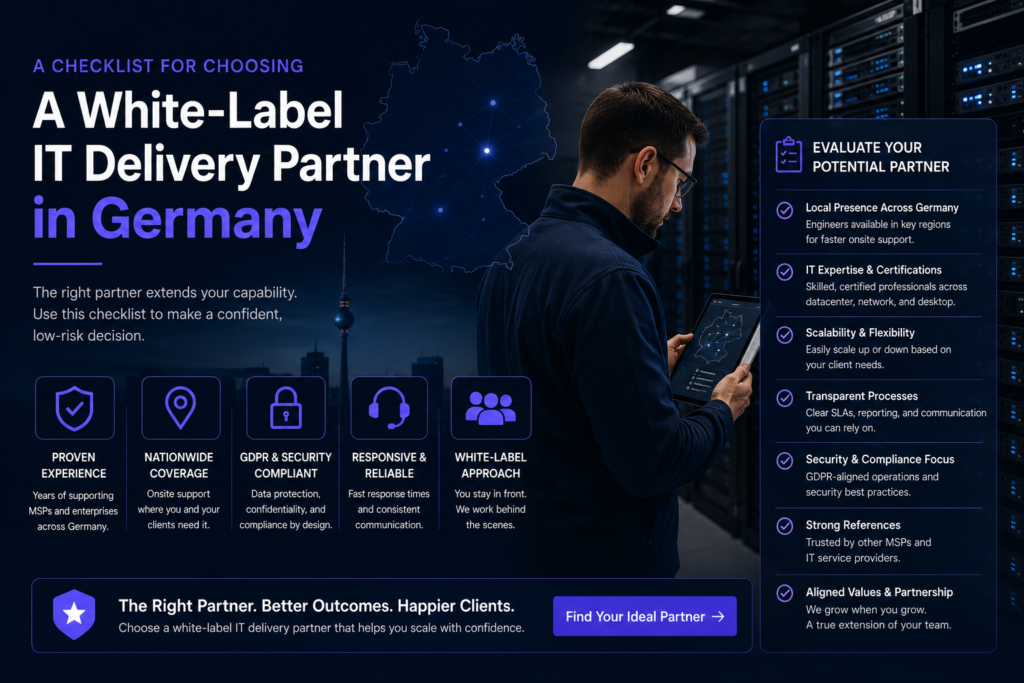
Choosing a white-label delivery partner is choosing who represents your brand when you’re not in the room. Get it wrong and the consequences show up in client churn, not just a bad invoice. Here’s a practical checklist to work through before you sign anything.
1. Confirm They’re Actually Invisible to Your Clients
Ask directly how they handle:
- Email communication: does it come from your domain, a shared inbox, or clearly theirs?
- Onsite visits: do engineers identify themselves as working for you, or mention another company?
- Documentation and reports branded as yours, or clearly third-party?
If any of these are vague or “flexible,” that’s a real gap, not a minor detail.
2. Check Real Coverage, Not Marketing Coverage
“Nationwide” and “across Germany” get used loosely. Ask specifically:
- Which regions do they have engineers actually based in?
- What’s the realistic dispatch time to a region they don’t have someone permanently in?
- Do they subcontract further for areas outside their core coverage and if so, does that break the white-label promise?
3. Verify GDPR Compliance Is Built In, Not Bolted On
This matters more in Germany than in most markets. Ask:
- How do they handle access to client systems and data during engagements?
- Do they have a standard Data Processing Agreement (DPA) ready, or are you expected to draft one?
- Where is their own infrastructure hosted, and does any data leave the EU?
A partner who can answer these specifically, without reaching for generic reassurance, is a good sign.
4. Understand How Escalation Actually Works
- Is there a single named point of contact, or does it depend who’s on shift?
- What happens if an onsite engineer hits something outside the agreed scope do they escalate, guess, or stall?
- How fast is the actual response time for urgent requests, in writing, not just “fast”?
5. Ask What Happens at Small Scale
Some providers are only worth engaging for large, ongoing contracts. Ask whether you can start with:
- A single project or one-off request
- A short trial period before committing to a longer engagement
- A specific region, rather than a company-wide rollout
A partner confident in their service usually has no problem starting small.
6. Look at Documentation Quality, Not Just Promises
Ask for a sample report or documentation format from a past (anonymized) engagement. This tells you more about day-to-day reliability than any sales conversation will.
7. Confirm Pricing Structure Matches Your Actual Usage Pattern
- Per-task pricing suits occasional remote hands needs
- Retainer or ongoing support pricing suits full datacenter or network support relationships
- Make sure you’re not paying for standing capacity you won’t use, or under-provisioned for the volume you actually expect
Putting It Together
None of these points are dealbreakers individually — a good partner might have a reasonable answer that doesn’t perfectly match every line above. What matters is whether they can answer specifically, with real detail, rather than defaulting to reassurance. Vague answers to specific questions are the clearest signal of how the actual engagement will go.
Where AleefTech Fits
AleefTech is built around exactly this checklist: genuine white-label delivery (not just outsourcing with a different label), real onsite coverage across Germany and the DACH region, GDPR-compliant operations from day one, a dedicated point of contact per engagement, and the flexibility to start with a single project before scaling up.