
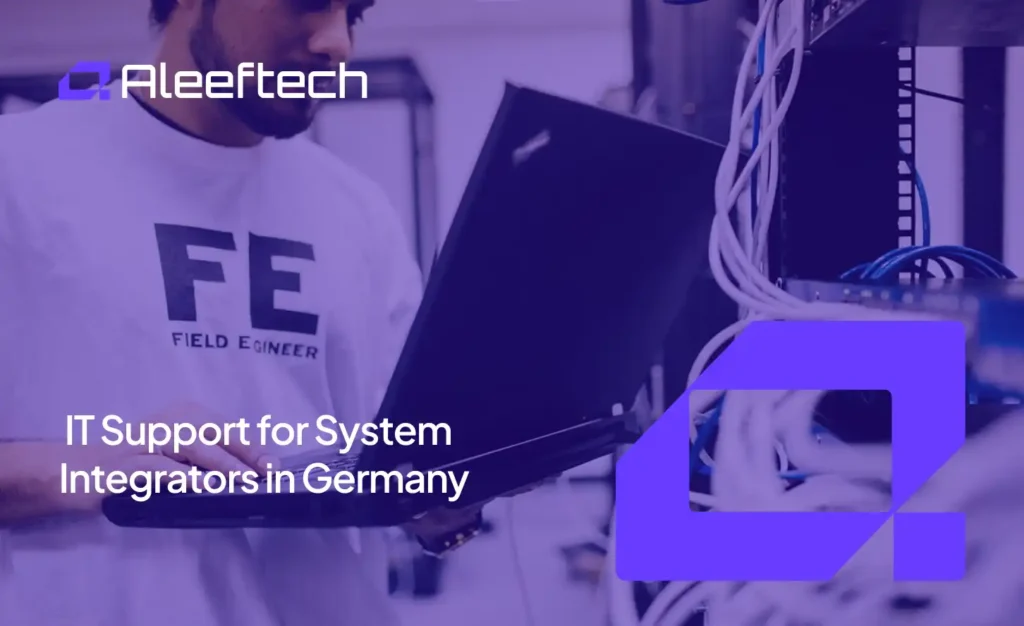
Winning a new IT project should be an opportunity to grow your business, not a reason to worry about whether you have enough engineers to deliver it.
For system integrators, every new customer brings additional responsibilities. You might need engineers to install network infrastructure, deploy hardware, configure workplace technology, support data center environments or provide hands-on assistance across multiple locations.
But maintaining a large engineering team across Germany isn’t always practical.
Recruitment takes time, operational costs continue to increase, and customer projects don’t always generate enough consistent demand to justify permanent hires.
This is where a reliable IT support partner can make a difference.
Aleef Technologies provides IT support for system integrators across Germany and the DACH region, helping IT service providers extend their engineering capacity through onsite IT support, network support, data center assistance and desktop and deskside services.
With flexible and white-label delivery options, system integrators can take on more projects, support customers in different locations and maintain their own client relationships without having to build an extensive local engineering workforce.
In this guide, we’ll explore the challenges system integrators face, the IT support services they need, how external engineering partnerships work and how these capabilities support different industries across Germany.
Why Do System Integrators Need Additional IT Support?
System integrators bring together hardware, software, networks and infrastructure to create technology environments that work together.
Their projects can involve designing IT architecture, implementing enterprise systems, deploying networks, integrating business applications and maintaining infrastructure after implementation.
However, successful project delivery requires more than technical planning.
Someone needs to install the equipment, connect the infrastructure, configure devices, troubleshoot physical issues and provide support at the customer’s location.
This creates several operational challenges.
1. Project Demand Doesn’t Always Match Internal Capacity
System integrators often experience fluctuations in project requirements.
One month, your team might be managing a small infrastructure upgrade. The next, you could be coordinating a large deployment across multiple customer locations.
Hiring permanent engineers for every potential requirement can increase overhead and make resource planning difficult.
External IT support gives you another way to access technical capacity when project demand increases.
2. Your Customers Operate Across Different Locations
A system integrator might manage infrastructure for customers in Frankfurt, Munich, Berlin, Hamburg and other German business centres.
Even when your central engineering team can handle architecture and remote troubleshooting, physical work still requires someone at the customer’s location.
Without regional support, your engineers may spend valuable time travelling instead of working on implementation and higher-value technical responsibilities.
3. Physical IT Work Requires Onsite Engineers
Not every IT problem can be solved remotely.
Hardware installation, structured cabling, network equipment replacement, workstation deployment and physical infrastructure inspections require onsite assistance.
When your internal team is unavailable, an external engineering partner can help complete these tasks.
4. Senior Engineers Spend Too Much Time on Routine Tasks
Your most experienced engineers should be focusing on architecture, complex integrations, technical planning and customer requirements.
However, they can easily become occupied with routine physical tasks that could be handled by appropriately qualified onsite technicians.
Delegating suitable activities helps your senior team focus on the work that requires their specialist knowledge.
5. Expanding Into New Industries Creates New Support Requirements
Different industries have different technology environments.
A retail customer might need support across multiple stores, while a manufacturing business may require assistance with network infrastructure connecting production environments.
Healthcare organisations have particular requirements around the availability and protection of information systems, while financial service providers place strong emphasis on security and operational controls.
System integrators need delivery partners who can understand these different environments and work within the customer’s technical and operational requirements.
What IT Support Services Do System Integrators Need?
The right support arrangement depends on the projects you deliver, the industries you serve and the technical capabilities available within your internal team.
For many system integrators, four areas are particularly important.
1. Onsite IT Support
Onsite IT support provides physical technical assistance at customer offices, branches, server rooms and other business locations.
It becomes particularly valuable when a project involves equipment installation, troubleshooting or work that cannot be completed remotely.
Common requirements include:
- Desktop and laptop installation.
- Hardware upgrades and replacements.
- Printer and peripheral configuration.
- Office IT deployments.
- Equipment relocations.
- Physical troubleshooting.
- Break-fix support.
- Infrastructure inspections.
Example: Multi-location workstation deployment
A system integrator wins a project to deploy new workstations across several customer offices in Germany.
Its central team handles planning, device preparation and configuration. However, each office requires technicians to install equipment, connect peripherals and verify that everything is working.
An onsite support partner can handle the physical deployment while the system integrator maintains responsibility for project coordination.
Explore Onsite IT Support Across Germany to learn more.
2. Network Support
Network infrastructure is central to almost every modern business environment.
System integration projects frequently involve routers, switches, firewalls, wireless access points, network cabinets and structured cabling.
Although network architecture and configuration can often be managed remotely, physical implementation still requires onsite assistance.
Network support requirements may include:
- Router and switch installation.
- Firewall hardware installation.
- Wireless access point deployment.
- Network cabling and patching.
- Physical connectivity checks.
- Hardware replacement.
- Network rack organisation.
- Onsite troubleshooting.
Example: Enterprise network upgrade
A system integrator is upgrading network infrastructure across a customer’s regional offices.
Its internal engineers design the network and prepare the configurations. Local technicians assist with installing switches, connecting equipment, organising cabling and verifying physical connections.
This allows the integration team to manage the technical design while onsite personnel complete the physical work.
Explore Aleef’s Network Onsite Support capabilities to learn more about physical network infrastructure assistance.
3. Data Center Support
System integrators working with enterprise infrastructure often need physical assistance inside data centers and server rooms.
These environments require careful coordination because even small physical changes can affect critical systems.
Typical requirements include:
- Server rack installation.
- Rack and stack activities.
- Hardware installation and replacement.
- Physical server inspections.
- Network and power cabling.
- Equipment relocation.
- Remote hands support.
- Hardware documentation.
Example: Server infrastructure deployment
A system integrator is implementing new server infrastructure for an enterprise customer.
The central team manages the architecture, planning and technical configuration. An onsite engineering partner assists with rack installation, equipment placement, cable connections and physical inspections.
The integration team retains technical ownership while the onsite engineers complete the agreed physical tasks.
Explore Data Center Support Services for more information.
4. Desktop and Deskside Support
Large IT projects often involve hundreds of individual end-user requirements.
Even when infrastructure is installed successfully, employees still need working devices, connected peripherals and access to their business systems.
Desktop and deskside support helps system integrators manage these requirements.
Common activities include:
- Desktop and laptop deployment.
- Device setup and replacement.
- Peripheral installation.
- Hardware troubleshooting.
- Workplace technology support.
- User device relocation.
- Device inventory assistance.
- Physical end-user support.
Example: Corporate office IT migration
A system integrator is supporting a company that is moving employees into a newly equipped office.
The central team manages the overall IT environment, while onsite technicians assist with workstation installation, monitor connections, device setup and basic hardware troubleshooting.
This reduces the physical workload on the core project team.
Explore Aleef’s Desktop and Deskside Support capabilities.
Which Industries Can System Integrators Support With External IT Engineering?
System integrators work with organisations across many industries, each with different infrastructure requirements.
A reliable engineering partner should understand that supporting a retail store is different from working in a manufacturing facility or healthcare environment.
Aleef Technologies identifies six industry segments in its service portfolio.
1. Enterprise IT Providers
Enterprise organisations operate complex IT environments that may include multiple offices, networks, servers, end-user devices and data center infrastructure.
System integrators supporting these businesses often need additional engineering capacity for deployments, infrastructure upgrades and ongoing technical support.
Common requirements include:
- Multi-location hardware deployments.
- Network infrastructure installation.
- Server and data center support.
- Office IT migrations.
- Desktop and deskside support.
- Hardware replacement and maintenance.
How external support helps
An external engineering partner can provide onsite resources for physical activities while the system integrator manages architecture, implementation planning and customer communication.
2. Healthcare
Healthcare organisations depend on technology to support administrative operations, clinical workflows, communication and access to information systems.
Hospitals, clinics and healthcare facilities may operate across multiple buildings and locations, creating complex onsite support requirements.
System integrators working in healthcare may need assistance with:
- Workstation and laptop deployment.
- Network connectivity.
- Hardware installation.
- Clinical workstation support.
- Server room and infrastructure assistance.
- Device replacement and physical troubleshooting.
How external support helps
Local engineering support can help system integrators coordinate physical IT tasks across healthcare locations without requiring their central technical team to travel for every installation or hardware issue.
Healthcare environments require particular care. Any onsite activity involving clinical systems or sensitive information must follow the healthcare organisation’s access, security, privacy and operational procedures.
3. Manufacturing
Manufacturing businesses depend on connected infrastructure to support production operations, communication, business applications and equipment management.
IT environments may include office networks, server infrastructure, production-adjacent systems, wireless networks and multiple industrial locations.
System integrators working in manufacturing may require:
- Network equipment installation.
- Switch and router replacement.
- Structured cabling.
- Server infrastructure support.
- Workstation deployment.
- Hardware inspections.
- Onsite troubleshooting.
- Infrastructure relocation assistance.
How external support helps
Onsite engineering resources can assist with physical IT infrastructure work while the system integrator maintains responsibility for system integration, network design and technical coordination.
For production environments, tasks should be planned carefully with the customer’s operational and engineering teams. IT support activities must not interfere with industrial control or production systems without appropriate authorisation.
4. Financial Services
Banks, financial institutions, insurance providers and other financial service organisations rely on secure and dependable IT infrastructure.
Their environments often involve strict internal security policies, controlled access and detailed operational procedures.
System integrators supporting financial service customers may need assistance with:
- Secure workstation deployment.
- Network infrastructure installation.
- Server room support.
- Hardware replacement.
- Office IT upgrades.
- Desktop and deskside support.
- Physical equipment inspections.
How external support helps
An engineering partner can provide physical assistance according to the customer’s approved procedures, allowing the system integrator to coordinate technical implementation across multiple locations.
Security clearances, confidentiality obligations, access restrictions and data protection requirements should be established before any external technician enters a financial services environment.
5. Retail
Retail businesses depend on technology across their stores, warehouses, offices and distribution environments.
Even a small infrastructure problem can affect daily operations, employee productivity and customer experience.
System integrators serving retail businesses may need support with:
- Point-of-sale hardware installation.
- Store network connectivity.
- Router and switch deployment.
- Wireless access point installation.
- Workstation and back-office device setup.
- Hardware replacement.
- Store openings and relocations.
- Multi-location IT rollouts.
How external support helps
A regional onsite support partner can assist with physical IT tasks across multiple store locations, allowing the system integrator to coordinate deployments without sending its central engineers to every site.
For businesses operating many stores, this can make project scheduling and resource allocation easier.
Connecting Industry Requirements With IT Support Services
Different industries have different infrastructure needs. The following table shows how system integrators can match those needs with appropriate onsite engineering capabilities.
| Industry | Common project requirements | Relevant support |
|---|---|---|
| Enterprise IT | Office deployments, infrastructure upgrades | Onsite, network and deskside |
| Healthcare | Workstations, connectivity, equipment support | Onsite, network and hardware support |
| Manufacturing | Network infrastructure, server environments | Network and data center support |
| Financial Services | Secure office infrastructure, hardware deployment | Onsite, network and deskside |
| Retail | POS infrastructure, store rollouts, connectivity | Onsite, network and hardware support |
The actual service scope should always be determined by the customer’s environment, technical requirements and security policies.
Explore Industries We Serve to learn more about the sectors Aleef supports.
How Does White-Label IT Support Work for System Integrators?
Not every system integrator wants to introduce another service provider directly to its customers.
In many cases, the preferred arrangement is to work with an external engineering partner that operates behind the system integrator’s brand.
This is known as white-label IT support.
Under a white-label arrangement, the system integrator maintains ownership of the customer relationship while the external provider delivers agreed technical services.
The customer continues working with the system integrator, while the partner provides additional engineering capacity.
A Typical White-Label Delivery Model
Step 1: The system integrator receives a project
A customer requests a network upgrade, hardware deployment or onsite IT support.
Step 2: The system integrator defines the requirements
The project team identifies the tasks that need additional onsite engineering resources.
Step 3: The support partner coordinates delivery
The partner confirms the location, scope of work, required skills, access permissions and scheduling.
Step 4: Engineers perform the agreed tasks
Onsite personnel complete the authorised physical work according to the agreed procedures.
Step 5: Results are documented
The partner provides task updates, completion notes and other agreed documentation.
Step 6: The system integrator manages the customer relationship
The system integrator reviews the work and communicates with its customer through its existing service delivery process.
Why System Integrators Choose White-Label Support
A white-label model can offer several operational advantages:
- Maintain direct ownership of customer relationships.
- Expand onsite support coverage.
- Access additional engineering capacity.
- Reduce the need for permanent local recruitment.
- Support projects in different regions.
- Handle temporary increases in project demand.
- Deliver additional services without building every capability internally.
The exact arrangement should be agreed in advance, including branding, customer communication, confidentiality, reporting and escalation responsibilities.
How to Choose the Right IT Support Partner in Germany
Choosing an external engineering partner is an important decision.
The partner may interact directly with your customers, access business infrastructure and represent your organisation during onsite activities.
A good technical fit is essential, but it isn’t the only consideration.
Here are eight factors system integrators should evaluate.
1. Geographic Coverage
Check whether the provider can support the locations where your customers operate.
Ask:
- Which German cities and regions are covered?
- Can the provider support multiple customer locations?
- Are engineers available for planned deployments?
- What happens when support is required outside the provider’s normal operating area?
2. Technical Capabilities
Evaluate whether the partner can support your actual project requirements.
Look for experience with:
- Hardware installation and replacement.
- Network infrastructure.
- Server environments.
- Data center operations.
- Desktop and deskside support.
- Onsite troubleshooting.
Don’t assume that every onsite technician can perform specialist network or infrastructure engineering work.
3. Communication and Reporting
Your partner should provide clear updates throughout the project.
Agree on:
- Task acceptance and confirmation.
- Engineer assignment.
- Arrival updates.
- Completion reports.
- Photographic evidence where appropriate.
- Escalation of unresolved issues.
This is especially important when your customer expects updates through your own service desk or project management system.
4. Flexible Engagement Models
Your support requirements may change from project to project.
Look for a provider that can discuss different arrangements, including:
- One-time onsite tasks.
- Short-term deployments.
- Multi-location projects.
- Hardware refresh programmes.
- Recurring support requirements.
- Longer-term engineering partnerships.
5. Security and GDPR
External engineers may need access to business locations, network equipment and systems containing sensitive information.
Before starting an engagement, clarify:
- Site access procedures.
- Identity verification.
- Confidentiality agreements.
- Customer-specific security policies.
- Data handling responsibilities.
- Subcontractor arrangements.
- Data processing agreements where applicable.
GDPR obligations depend on the actual processing activities and contractual roles. Working with a local provider does not automatically establish GDPR compliance.
For further information, consult the European Commission’s GDPR guidance.
6. White-Label Compatibility
If you intend to deliver services under your own brand, make sure the provider can work within your service delivery model.
Discuss branding, customer communication, reporting formats, escalation contacts and confidentiality arrangements.
7. Transparent Pricing
Before assigning work, understand what is included in the commercial agreement.
Clarify:
- Hourly and fixed-task pricing.
- Minimum booking periods.
- Travel expenses.
- Emergency charges.
- Additional materials.
- Out-of-scope activities.
- Cancellation policies.
Clear pricing and responsibilities help you protect project margins and avoid unexpected costs.
8. Escalation and Accountability
A dependable partner should have a clear process when a task cannot be completed as planned.
Agree on who:
- Approves additional work.
- Makes technical decisions.
- Communicates unexpected issues.
- Handles customer escalation.
- Signs off on completed activities.
These responsibilities should be documented before the project begins.
What Should an IT Support SLA Include for System Integrators?
A Service Level Agreement (SLA) establishes service expectations and responsibilities between the system integrator and its support partner.
For multi-location IT projects, an SLA helps prevent misunderstandings about availability, response times and task completion.
A practical agreement should cover:
| SLA element | What should be agreed |
|---|---|
| Request acknowledgement | Time to confirm a support request |
| Engineer assignment | Expected dispatch coordination |
| Onsite arrival | Agreed arrival window |
| Scope of work | Authorised technical activities |
| Operating hours | Standard and emergency availability |
| Escalation | Procedure for unexpected issues |
| Reporting | Completion notes and documentation |
| Communication | Project contacts and update frequency |
| Pricing | Standard and additional charges |
Important: Acknowledgement time, dispatch time and onsite arrival time are separate commitments. Make sure they are defined separately in the agreement.
How Much Does Outsourced IT Support Cost for System Integrators?
There is no universal price for outsourced IT support.
Costs depend on the technical requirements, location, project duration and level of engineering expertise needed.
Common pricing considerations include:
Type of work: A basic hardware installation may require less time and specialist expertise than a complex network deployment.
Location: Travel distance and regional availability can affect the cost of onsite support.
Project duration: A single support visit and a multi-week deployment have different resource requirements.
Urgency: Emergency requests and out-of-hours work may involve additional charges.
Technical expertise: Specialist infrastructure and network tasks may require more experienced engineers.
Equipment and materials: Additional hardware, cabling or specialist tools may increase the project cost.
Should You Hire or Outsource Additional Engineers?
For system integrators, the decision often comes down to demand consistency.
| Consideration | Permanent hiring | External engineering partner |
|---|---|---|
| Resource availability | Depends on recruitment and staffing | Depends on agreed provider capacity |
| Fixed employment costs | Ongoing | Usually engagement-based |
| Regional coverage | Requires local staffing | Can extend through provider coverage |
| Project flexibility | Less flexible for fluctuating demand | Can be more flexible |
| Internal management | Direct management | Requires coordination and clear scope |
| Technical control | Direct | Shared according to agreed responsibilities |
External support isn’t automatically cheaper or better for every situation. Permanent hiring may make more sense when demand is predictable and continuous.
However, when project requirements fluctuate or involve multiple locations, an external engineering partnership can provide useful flexibility.
How Aleef Technologies Supports System Integrators Across Germany
System integrators need a delivery partner that understands the difference between providing a technician and supporting an actual IT project.
Aleef Technologies works with system integrators, MSPs and enterprise IT providers that need additional engineering capacity across Germany and the DACH region.
Our services are designed to complement your existing technical team, helping you manage physical IT requirements while maintaining your customer relationships.
Onsite IT Support
We support physical IT activities at customer locations, including hardware installation, troubleshooting, maintenance and office IT requirements within the agreed service scope.
Network Support
We assist with physical network infrastructure tasks involving routers, switches, firewalls, wireless equipment and cabling.
Data Center Support
We provide support for infrastructure environments that require onsite assistance, hardware-related activities and physical coordination.
Desktop and Deskside Support
We help with workplace device deployment, hardware issues and end-user support requirements.
White-Label Delivery
Our white-label model allows system integrators to extend their service delivery capacity while keeping the customer relationship under their own brand.
Clear Communication and Reporting
We focus on defined task requirements, communication and documentation so your team can maintain visibility over the work being performed.
Our approach is built around three principles:
Your customers remain your customers.
We support your delivery operation rather than competing for your customer relationships.
Your team maintains technical ownership.
Your engineers remain responsible for the wider project architecture, technical decisions and customer requirements.
Your delivery capacity can grow with demand.
You can discuss additional onsite engineering resources as your projects and customer requirements change.
Explore our Onsite IT Support, Data Center Support and Industries We Serve pages to learn more.
Frequently Asked Questions About IT Support for System Integrators
1. Why do system integrators outsource IT support?
System integrators outsource IT support when they need additional engineering capacity, regional coverage or specialist onsite assistance. This can help them manage fluctuating project demand without immediately expanding their permanent workforce.
2. What services can an IT support partner provide to system integrators?
Depending on the provider, services may include onsite IT support, network installation, hardware replacement, data center assistance, remote hands, desktop deployment and deskside support.
3. Can external engineers work under a system integrator’s brand?
Yes. Through a white-label arrangement, external engineers can deliver agreed services behind the system integrator’s brand. Branding, communication, reporting and confidentiality responsibilities should be defined in the agreement.
4. Can system integrators use external IT engineers for short-term projects?
Yes. External engineering support can be arranged for individual onsite tasks, temporary deployments, hardware refresh projects and other defined requirements, depending on provider availability.
5. Which industries can benefit from outsourced IT support?
Enterprise IT providers, healthcare organisations, manufacturing businesses, financial service providers and retail companies can all require additional physical IT support. The specific requirements depend on their infrastructure, security policies and operating environments.
6. How does outsourced IT support help with multi-location projects?
A regional support partner can provide onsite resources across different customer locations. This helps system integrators coordinate physical installations, device deployments and infrastructure work without sending the same internal engineers to every site.
7. Is outsourced IT support suitable for GDPR-sensitive environments?
It can be, provided the engagement follows the customer’s applicable security, access and data protection requirements. Contractual responsibilities and any data processing arrangements should be assessed before work begins.
8. How do I choose an IT support partner in Germany?
Evaluate geographic coverage, technical capabilities, communication, reporting, security procedures, white-label delivery options, pricing and escalation processes. Make sure the provider can support your actual project requirements.
9. Can Aleef Technologies support both individual projects and ongoing requirements?
Aleef’s service model covers onsite, network, data center and desktop support requirements. You can discuss individual project needs as well as recurring support arrangements through an initial assessment.
10. Does Aleef Technologies work only with system integrators?
No. Aleef Technologies also works with MSPs, enterprise IT providers and businesses that need direct or white-label IT support.
Ready to Expand Your IT Delivery Capacity?
You shouldn’t have to turn down a promising project because your internal team doesn’t have enough engineers available.
Whether you’re managing an enterprise infrastructure deployment, supporting retail locations, working with healthcare organisations or delivering network projects for manufacturing customers, having the right onsite engineering partner can make project coordination easier.
Aleef Technologies helps system integrators extend their IT support capabilities across Germany and the DACH region through onsite engineering, network support, data center assistance and desktop and deskside services.
Have an upcoming IT project or need additional engineering capacity?
Tell us about your customer locations, technical requirements and the type of support you need.
Contact Aleef Technologies to discuss your project requirements and explore how we can support your delivery operation.


 English
 German