


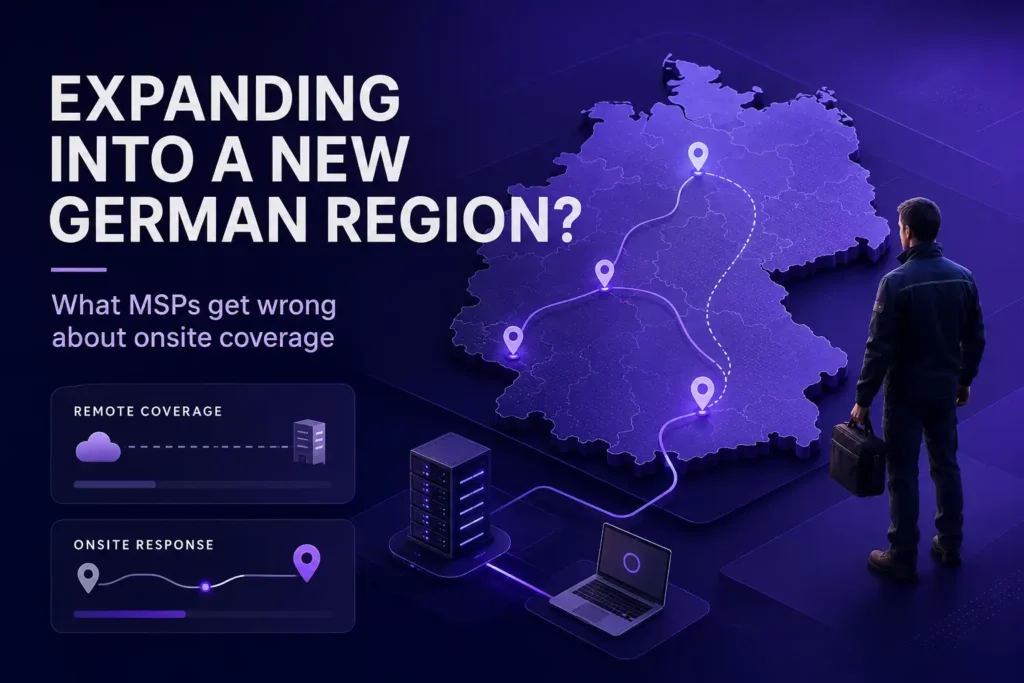
Winning a client in a new region feels like a straightforward win until you realize your onsite coverage doesn’t reach them. This is one of the most common, and most avoidable, mistakes growing MSPs make when expanding across Germany.
The Mistake: Assuming Remote Support Covers Everything
Remote support handles a large share of day-to-day IT work, but it can’t install hardware, run cabling, or physically diagnose a failed component. The moment a new regional client needs anything physical — and eventually, they will the gap becomes visible fast, usually during an incident, which is the worst possible time to discover it.
The Second Mistake: Hiring Too Early
The opposite error is just as costly: hiring a local engineer the moment you win a client in a new region, before you know whether that region will generate enough ongoing work to justify a permanent hire. This locks in cost against uncertain, unproven demand.
The Third Mistake: Underestimating Real Response Times
“We cover all of Germany” often means engineers based in one or two metro areas, with everything else covered by long drives or next-day-at-best response. If your new client’s environment has genuine uptime requirements, discovering your real dispatch time during a live incident rather than before you signed the contract is not where you want to be.
What a Better Approach Looks Like
Test the region before committing to it. Use a delivery partner with existing coverage to serve the new region while you gather real data on how much ongoing work it generates.
Separate “coverage exists” from “coverage is fast.” Ask any potential partner for actual dispatch time estimates to the specific city or region your client is in not a general claim about national coverage.
Plan for both planned and reactive work from day one. A new regional client will eventually need both routine onsite work (deployments, refreshes) and reactive break-fix support. Make sure whatever coverage you arrange handles both, not just emergencies.
Keep the client relationship entirely yours. Whatever coverage solution you use for a new region, make sure it doesn’t introduce a visible third party to the client relationship you just won. A white-label delivery partner solves the coverage gap without diluting the relationship.
A Practical Sequence for Expansion
- Win the client or identify the opportunity in the new region
- Confirm real, specific coverage and dispatch times from a delivery partner for that exact location
- Deliver service through that partner while tracking actual demand and incident volume
- Reassess after a defined period (e.g., 6–12 months) whether the region justifies a permanent local hire — using real data instead of a guess made at signing
This sequence lets you say yes to regional opportunities immediately, without the two failure modes of stretched-thin remote support or premature hiring.
Where AleefTech Fits
AleefTech provides onsite engineering coverage across Germany and the DACH region specifically for MSPs navigating this exact expansion problem — real dispatch times, white-label delivery that keeps your client relationship intact, and the flexibility to start with a single region before scaling further.