

MSPs often reach out asking for “remote hands” when what they actually need is ongoing datacenter support or the reverse, expecting a full support relationship when a single one-off task would solve the problem. Knowing which one you actually need saves time and, often, money.
The Core Difference
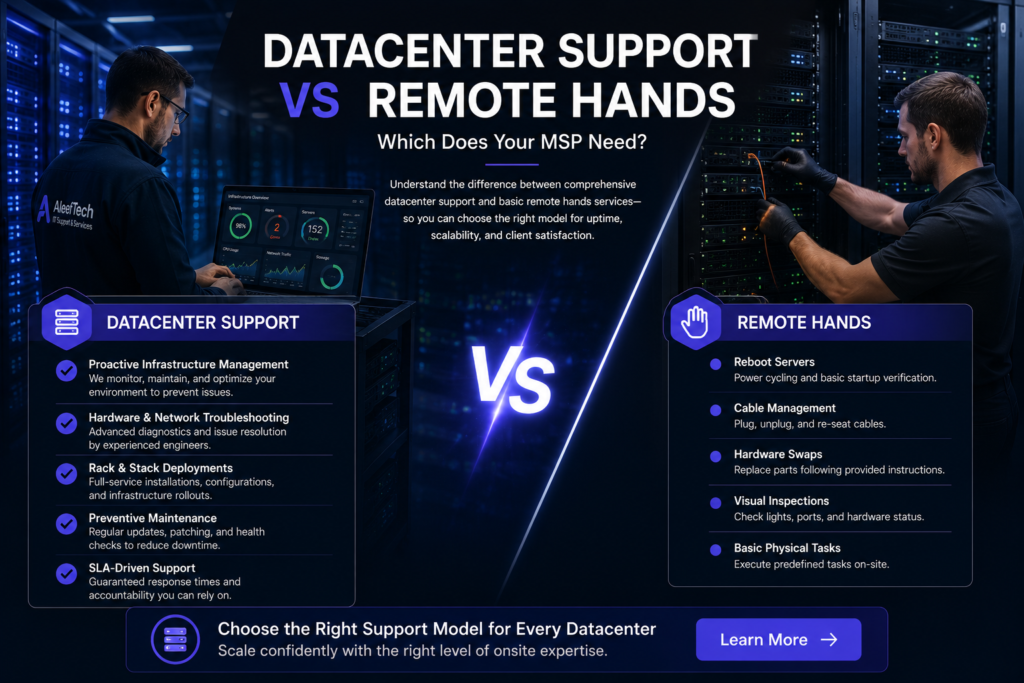
Remote hands is task-based: a specific physical job, done once, on request. Install this drive. Reseat this cable. Photograph this rack. It’s reactive, and each request stands alone.
Datacenter support is relationship-based: ongoing monitoring, patching, capacity planning, preventive maintenance, and incident response, delivered continuously over time — with remote hands as one component of a much broader service.
When Remote Hands Is Enough
- You need a single physical task completed and already know exactly what it is
- The request is a one-off — a hardware swap during a migration, a cabling fix, a rack reorganization
- You have your own monitoring and management in place, and just need physical presence occasionally
- Cost predictability matters more than proactive coverage — you’re paying per task, not for standing capacity
When You Need Full Datacenter Support
- You’re responsible for a client’s infrastructure uptime on an ongoing basis, not just individual incidents
- You want proactive monitoring that catches problems before they become outages
- Patch management, backup verification, and capacity planning need to happen on a schedule, not just when something breaks
- You’re managing multiple client environments and want a single, consistent support relationship rather than ad hoc requests
A Practical Way to Decide
Ask: if this specific piece of infrastructure had a serious failure at 2am, whose responsibility is it to have caught the warning signs beforehand?
If the honest answer is “nobody’s, because nobody’s actively watching it,” that’s a sign you need datacenter support, not just remote hands. If the answer is “our monitoring already caught it, we just need someone physically there,” remote hands is the right scope.
They’re Not Mutually Exclusive
Many MSPs start with occasional remote hands requests for a specific client, and expand into full datacenter support as that relationship grows — or the reverse, scaling down from full support to occasional remote hands once a client’s infrastructure stabilizes. A good delivery partner should be able to flex between the two without forcing you into a bigger commitment than the situation calls for.
Where AleefTech Fits
AleefTech offers both, structured to match where your client relationship actually is: standalone remote hands services for specific tasks, and full datacenter support — server installation, monitoring, patching, incident response, capacity planning — for MSPs and Enterprise IT providers across Germany who need ongoing coverage. Same engineers, same GDPR-compliant standards, scoped to what you actually need.