
When a server stops responding, a network connection fails, or a hardware component needs replacing, remote troubleshooting isn’t always enough. Sometimes, someone needs to be physically present at the data center to investigate and resolve the problem.
But what happens when your IT team is hundreds of kilometres away?
This is where remote hands services become essential.
Remote hands services provide Managed Service Providers (MSPs), system integrators and enterprise IT teams with access to onsite technicians who can perform physical IT infrastructure tasks on their behalf. Instead of sending your own engineers across the country, you can delegate specific tasks to a local support partner while retaining control of the technical operation.
For businesses managing infrastructure across multiple locations, remote hands can help reduce unnecessary travel, simplify onsite coordination and extend physical IT support coverage.
In this guide, we’ll explain what remote hands services include, when you actually need them, how they differ from smart hands and full data center support, what they cost, and how to choose a reliable remote hands provider in Germany.
What Are Remote Hands Services?
Remote hands services involve physical IT support performed by an onsite technician at a data center, server room or business location, following instructions from a remote IT team.
The remote team remains responsible for identifying the issue, deciding what needs to be done and providing technical instructions. The onsite engineer carries out the physical work and reports the results.
Think of remote hands as an extension of your existing IT team. You get physical assistance at locations where you don’t have permanent staff without necessarily hiring additional engineers or arranging travel for every support request.
How Do Remote Hands Services Work?
Consider an MSP based in Munich that manages a customer’s server infrastructure in Frankfurt.
The MSP monitors the customer’s systems remotely. One morning, an alert indicates that a server has lost connectivity. After checking the network configuration, the technical team suspects a physical connection problem.
However, nobody from the MSP’s internal team is available to visit the data center.
Instead of arranging a technician’s journey from Munich, the MSP contacts a remote hands provider. An authorised onsite engineer visits the designated rack, checks the relevant physical connections, captures photographs and reports the findings.
The MSP reviews the information and decides what should happen next.
The remote team remains responsible for technical decisions, while the onsite engineer provides the physical presence required.
What Tasks Do Remote Hands Engineers Perform?
The exact scope depends on the provider, data center requirements and agreed service arrangements. Common tasks include:
1. Server installation and replacement
- Installing servers in designated rack positions.
- Removing or replacing faulty hardware.
- Connecting power and network cables.
- Checking equipment indicators and physical connections.
- Assisting with approved component replacements.
2. Rack and stack services
- Mounting servers, switches and other rack equipment.
- Organising equipment within server racks.
- Labelling cables and hardware.
- Documenting rack layouts and equipment positions.
- Supporting equipment relocation.
3. Network and cabling support
- Connecting and disconnecting network cables.
- Replacing faulty patch cables.
- Checking physical network connections.
- Inspecting switches and patch panels.
- Verifying designated physical connectivity.
4. Hardware troubleshooting
- Inspecting server status indicators.
- Checking power connections and hardware components.
- Reseating approved components.
- Performing authorised power cycles and resets.
- Reporting visible hardware faults.
5. Equipment inspections and documentation
- Capturing photographs of equipment and rack configurations.
- Recording serial numbers and asset information.
- Checking physical equipment conditions.
- Reporting completed tasks and unresolved issues.
- Updating equipment records where agreed.
6. Physical media handling
- Performing authorised backup media exchanges.
- Collecting or transferring designated hardware.
- Supporting approved physical equipment movements.
- Following documented media handling and chain-of-custody procedures.
Not every remote hands provider offers all these services. Before assigning a task, confirm that the engineer has the required experience, permissions, tools and technical capabilities.
When Does Your Business Actually Need Remote Hands Support?
Remote hands services are particularly useful when your IT infrastructure is distributed across multiple locations or your internal team cannot reach a site quickly enough.
Here are six situations where they can make a practical difference.
1. Your IT Infrastructure Is Located in Another City
Managing servers and network equipment across different locations creates a physical support challenge.
Your engineers might be able to diagnose a problem remotely, but they cannot physically replace a failed component or inspect a disconnected cable.
Remote hands gives your team access to local technical assistance without arranging unnecessary travel.
Example: An MSP based in Munich manages infrastructure for a customer whose equipment is hosted in a Frankfurt data center. A physical inspection is required after a hardware alert. A local remote hands engineer can carry out the inspection and report the findings to the MSP.
2. You Need Physical Assistance During an Infrastructure Incident
Remote troubleshooting has limitations.
When a device loses power, a cable becomes disconnected or a hardware component fails, someone may need to inspect the equipment directly.
An onsite engineer can:
- Check physical power connections.
- Inspect server and network equipment.
- Identify visible hardware issues.
- Follow authorised troubleshooting instructions.
- Provide photographs and status updates.
This gives your remote team additional information to make informed decisions about the next steps.
Remote hands does not replace incident management or advanced engineering expertise. It provides the physical assistance required to support those activities.
3. You Want to Reduce IT Support Travel Costs
Sending an engineer to another city for a short physical task can create unnecessary expenses.
Travel time, transportation, accommodation and scheduling can make a simple hardware replacement more expensive than expected.
Remote hands offers an alternative by allowing a local engineer to complete the physical work.
Instead of sending your own technician for a straightforward task, your team can coordinate the work remotely and focus on higher-value technical responsibilities.
The financial benefit depends on the distance, task duration, provider charges and your internal staffing costs. It is worth comparing the complete cost of both options before making a decision.
4. You’re Expanding Your MSP Services Into New Regions
Winning customers in new geographical areas is an opportunity for MSPs, but it also creates operational challenges.
You might have the technical expertise to manage a customer’s infrastructure but lack local engineers to perform physical tasks.
Building an internal team in every location can be expensive, particularly when customer demand is inconsistent.
A remote hands partner can help extend your physical support coverage without requiring immediate local recruitment.
This allows MSPs and system integrators to explore new markets while maintaining a consistent service delivery model.
5. You Need Hardware Installation or Replacement
Not every infrastructure task can be completed remotely.
Installing a new server, replacing a switch, organising rack equipment or reconnecting physical cables requires someone onsite.
Remote hands engineers can perform these activities according to your team’s instructions and the agreed scope of work.
For more complex installations, the provider should confirm whether additional engineering expertise, site access permissions or specialist tools are required.
6. You Need Support Across Multiple Customer Locations
MSPs often manage infrastructure for several customers operating in different cities or regions.
Coordinating individual technician visits for every physical support request can become difficult.
A reliable remote hands arrangement helps standardise:
- Task requests and work instructions.
- Engineer dispatch and site coordination.
- Physical task execution.
- Completion reports and photographs.
- Escalation of unresolved issues.
- Communication with the customer’s IT team.
This makes it easier to coordinate onsite work across a distributed customer environment.
Remote Hands vs Smart Hands vs Full Data Center Support
These terms are often used interchangeably, but they can describe different levels of technical involvement.
Understanding the differences helps you choose the right support model.
| Service | What it involves | Typical example |
|---|---|---|
| Remote Hands | Physical tasks performed under remote instructions | Replacing a cable or power cycling a server |
| Smart Hands | More technically involved onsite tasks requiring additional expertise | Hardware diagnostics or guided configuration |
| Full Data Center Support | Broader infrastructure support and operational activities | Infrastructure maintenance and coordinated incident support |
What Is the Difference Between Remote Hands and Smart Hands?
Remote hands generally focuses on physical execution.
Your remote team provides the instructions, and the onsite engineer completes the requested task.
Smart hands usually involves a higher level of technical involvement. Depending on the provider, this may include more advanced diagnostics, troubleshooting, hardware configuration and technical problem-solving.
For example:
- A remote hands engineer might replace a designated network cable.
- A smart hands engineer might assist with a more complex hardware diagnostic procedure under an approved technical plan.
However, there is no universally consistent distinction between these service labels. Some providers use them interchangeably.
Before engaging a provider, ask for a detailed service scope rather than relying on the terminology alone.
When Do You Need Full Data Center Support?
Remote hands is often suitable for individual physical tasks.
However, businesses managing complex infrastructure may require broader support arrangements covering recurring maintenance, infrastructure operations, coordinated troubleshooting and ongoing onsite assistance.
For these requirements, a dedicated data center support arrangement may be more appropriate.
Explore Aleef’s Data Center Support Services to understand how broader infrastructure support can complement task-based remote hands services.
How Do Remote Hands Services Work? A Five-Step Process
A well-organised remote hands engagement should follow a clear process.
Although the exact workflow varies between providers, the following steps represent a typical engagement.
Step 1: Submit a Support Request
Your IT team identifies a physical task that requires onsite assistance.
You provide the relevant information, including:
- Data center or customer site location.
- Rack number and equipment identification.
- Description of the issue.
- Required physical task.
- Site access requirements.
- Requested completion timeframe.
- Relevant contact details.
Clear instructions help the onsite engineer understand the task before arriving at the location.
Step 2: Confirm Scope and Site Access
The service provider reviews the request and confirms whether the task falls within the agreed service scope.
This may include checking:
- Engineer availability.
- Site access permissions.
- Required tools and equipment.
- Hardware compatibility.
- Change approval requirements.
- Estimated task duration.
For data center environments, access must follow the facility’s authorisation and security procedures.
Step 3: Dispatch an Onsite Engineer
Once the request is approved and scheduled, an engineer is assigned to the location.
The engineer receives the relevant instructions and coordinates with your team if clarification is needed.
The service provider should also confirm the expected arrival time and escalation contact.
Step 4: Execute the Physical Task
The onsite engineer performs the authorised work.
This could involve inspecting a server, replacing a cable, installing equipment or checking a network connection.
For tasks involving sensitive infrastructure, the engineer should follow the approved change procedure and obtain confirmation before performing any action that could interrupt services.
If the task cannot be completed as expected, the engineer should stop, document the situation and escalate it to the responsible technical team.
Step 5: Document and Report the Results
After completing the task, the engineer provides a report describing the work performed.
Depending on the agreed reporting requirements, this can include:
- Work completion status.
- Photographs before and after the task.
- Equipment identification.
- Actions performed.
- Outstanding issues.
- Recommendations for further investigation.
- Time spent onsite.
Your internal team can then review the results and determine whether additional work is necessary.
Example: What a Real Remote Hands Request Looks Like
Understanding the workflow becomes easier when you look at a practical scenario.
Consider an MSP managing a customer’s network infrastructure in a Frankfurt data center.
The problem
The monitoring system reports that a server has lost network connectivity. The remote IT team checks the configuration and suspects a physical connection issue.
The remote hands request
The MSP submits a request containing:
- Site: Customer’s Frankfurt data center.
- Location: Designated rack and equipment position.
- Device: Identified server.
- Task: Inspect the designated network connection.
- Instructions: Check the physical connection and report the findings.
- Restrictions: Do not disconnect or replace anything without approval.
The onsite activity
An authorised engineer visits the rack, checks the relevant cable connection and documents the physical condition.
The report
The engineer submits photographs and a completion report describing the findings.
The resolution
The MSP reviews the evidence and decides whether to approve a cable replacement or investigate another possible cause.
This example demonstrates an important principle: remote hands should work as an extension of your technical operation, not as an independent team making unauthorised changes.
This is an illustrative scenario, not a verified Aleef customer case.
What Should You Look for in a Remote Hands Provider?
Choosing the right remote hands provider is about more than finding someone who can visit a data center.
You need a partner who understands your operational requirements, follows instructions accurately and communicates clearly with your technical team.
Here are eight factors to evaluate.
1. Geographic Coverage
Check whether the provider can support the locations where your customers operate.
A provider may advertise nationwide coverage but rely on a limited network of technicians.
Ask:
- Which cities and regions are covered directly?
- Which locations are supported through subcontractors?
- Are travel or dispatch fees applicable?
- Can the provider support multiple customer locations?
- Is local support available for urgent requests?
For MSPs operating across Germany, regional coverage is particularly important.
2. Engineer Experience and Technical Capability
Not every onsite technician is suitable for every infrastructure task.
Ask about the team’s experience with:
- Server hardware.
- Network equipment.
- Rack and stack installations.
- Structured cabling.
- Hardware replacement.
- Data center environments.
- Equipment documentation.
Make sure the provider can distinguish between tasks that require basic physical assistance and those that need specialist engineering expertise.
3. Response Times and Availability
Infrastructure issues do not always happen during standard business hours.
Before signing an agreement, clarify:
- Standard operating hours.
- Emergency support availability.
- Request acknowledgement targets.
- Engineer dispatch targets.
- Onsite arrival targets.
- Escalation procedures.
- Weekend and holiday coverage.
Ask for specific contractual service levels rather than accepting vague promises of fast response.
4. Reporting and Documentation
A completed task should be properly documented.
Your team needs to know what happened, what was changed and whether the issue was resolved.
Look for providers that can deliver structured work reports, equipment details, photographs and clear completion updates.
For MSPs, documentation is especially important because they may need to provide evidence of the work to their own customers.
5. Security and GDPR Considerations
Remote hands engineers may enter controlled data center environments or interact with equipment containing sensitive business information.
Security should therefore be part of the engagement from the beginning.
Consider:
- Site access authorisation.
- Identity verification.
- Confidentiality agreements.
- Access restrictions.
- Secure handling of equipment and media.
- Incident reporting procedures.
- Appropriate data processing agreements where personal data processing is involved.
- Clear procedures for subcontractor access.
The GDPR does not automatically make every onsite technician a data processor. The applicable roles depend on the actual activities and access involved.
Where a provider processes personal data on behalf of a customer, GDPR Article 28 requires appropriate contractual arrangements and sufficient guarantees concerning technical and organisational measures.
Read the European Commission’s guidance on GDPR application and Article 28 of the GDPR.
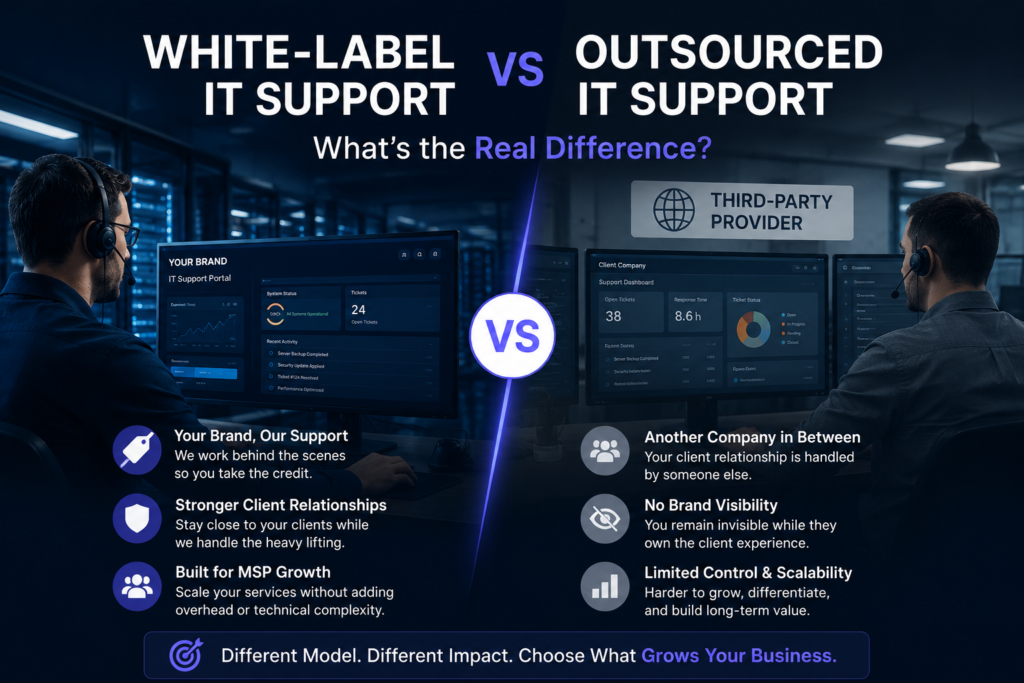
6. White-Label Service Delivery
For MSPs and system integrators, maintaining customer relationships and brand consistency is essential.
A white-label remote hands partner works as an extension of your service delivery operation, allowing your organisation to coordinate the customer relationship while the partner performs the agreed onsite work.
Before engaging a provider, clarify:
- Whether engineers can operate under your brand.
- How customer communication is handled.
- Who receives the completion reports.
- How escalation is managed.
- What confidentiality and non-solicitation arrangements apply.
- How customer information is protected.
The goal is to provide a consistent experience without exposing customers to unnecessary operational complexity.
7. Transparent Pricing
Remote hands pricing can vary depending on the location, task complexity, urgency and duration of work.
Ask for clarity on:
- Hourly or fixed-task rates.
- Minimum booking periods.
- Travel charges.
- Emergency dispatch fees.
- Equipment and material costs.
- Out-of-scope work.
- Cancellation charges.
A transparent pricing structure makes it easier to calculate service delivery costs and protect your margins.
8. Escalation and Accountability
Not every physical support request can be completed successfully on the first visit.
A reliable provider should have a clear escalation process when:
- Equipment is inaccessible.
- The fault is different from the reported issue.
- Required parts are unavailable.
- The task exceeds the engineer’s agreed scope.
- An unexpected service interruption occurs.
- Additional technical expertise is required.
Your agreement should establish who makes technical decisions, who approves additional work and who communicates with the customer.
What Should a Remote Hands SLA Include?
A Service Level Agreement (SLA) defines the responsibilities and service expectations between the customer and provider.
For MSPs, this is particularly important because the onsite provider’s performance can directly affect the service delivered to the MSP’s own customers.
A useful remote hands SLA should define the following elements:
| SLA element | What should be agreed |
|---|---|
| Request acknowledgement | How quickly the provider confirms receipt |
| Dispatch target | Expected time to assign an engineer |
| Onsite arrival | Agreed arrival window |
| Operating hours | Standard and emergency availability |
| Task scope | What the engineer is authorised to perform |
| Escalation | How unexpected issues are handled |
| Reporting | Required photographs and completion documentation |
| Communication | Who receives updates and reports |
| Pricing | Standard, emergency and additional charges |
Example SLA Framework
The following is an illustrative framework, not a service commitment or published Aleef SLA.
| Service level | Example requirement |
|---|---|
| Standard request | Acknowledge during agreed business hours |
| Urgent request | Prioritised acknowledgement and dispatch coordination |
| Emergency request | Escalation through an agreed emergency contact |
| Task completion | Report completion or explain outstanding issues |
| Failed task | Document the reason and escalate to the technical owner |
Avoid choosing a provider based only on advertised response times. Check whether the SLA distinguishes between acknowledgement, dispatch and actual onsite arrival.
These are three different measurements.
How Much Do Remote Hands Services Cost?
There is no single price for remote hands services.
Costs depend on several factors, including:
Location: The distance between the engineer and the site can affect travel and dispatch charges.
Task complexity: A simple visual inspection generally requires less time and expertise than a server installation or complex hardware replacement.
Duration: Some providers charge hourly, while others offer fixed rates for defined tasks.
Urgency: Emergency or out-of-hours requests may have different pricing arrangements.
Additional requirements: Specialised equipment, additional technicians or site-specific access arrangements may increase the overall cost.
Service frequency: Businesses requiring recurring support may be able to negotiate a different commercial arrangement from those requesting occasional assistance.
How to Compare Remote Hands Costs
Rather than comparing hourly rates alone, calculate the total cost of completing the task.
For example, an internal technician dispatch might involve:
- Engineer working hours.
- Travel time.
- Transportation expenses.
- Accommodation, if necessary.
- Scheduling and coordination.
- Opportunity cost of taking the engineer away from other work.
Compare these expenses with the remote hands provider’s service fee, travel charges and any additional costs.
For MSPs, this calculation can also help determine how to price onsite support within their own customer contracts.
Remote Hands Services in Germany: What MSPs Should Know
Germany is one of Europe’s major data center markets, with Frankfurt serving as its largest established data center hub.
According to the German Datacenter Association’s Datacenter Outlook Germany 2026/27, Germany has more than 1.5 GW of data center capacity in operation, while Frankfurt accounts for approximately 1,274 MW of capacity.
Other important data center regions include Berlin-Brandenburg, Munich, Cologne-Düsseldorf and Hamburg.
These developments create opportunities for MSPs and IT service providers, but they also make regional physical support an important operational consideration.
You can explore the German Datacenter Association’s 2026/27 outlook and Germany’s data center landscape overview from Germany Trade & Invest.
Challenges of Managing Infrastructure Across Germany
MSPs supporting customers across multiple German locations may face several challenges:
1. Geographic coverage
Your internal team might be based in one city while customer infrastructure is located elsewhere. Coordinating physical support across different regions requires reliable local coverage.
2. Data center access requirements
Different facilities have their own access procedures, security policies and authorisation requirements. Engineers must be properly approved before carrying out onsite work.
3. Consistent service documentation
When multiple engineers or support partners handle customer requests, maintaining consistent documentation becomes important.
4. Customer communication
MSPs need to maintain visibility over the tasks performed on behalf of their customers, including outstanding issues and follow-up requirements.
5. Security and compliance
Customer-specific confidentiality, access control and data protection obligations must be considered before granting third-party personnel access to infrastructure.
What Should German MSPs Look for in a Local Support Partner?
A suitable partner should offer more than geographical availability.
Look for:
- Relevant onsite infrastructure experience.
- Clear task acceptance procedures.
- Defined response and dispatch arrangements.
- Consistent reporting.
- Secure access management.
- Transparent pricing.
- Ability to work within a white-label delivery model.
- Clear escalation and communication procedures.
The objective is to establish a dependable operational relationship that supports your existing IT service delivery model.
When Remote Hands Is Not Enough
Remote hands can solve many physical infrastructure challenges, but it is not a replacement for every type of IT support.
Understanding its limitations helps businesses assign the right people to the right tasks.
Complex Software Troubleshooting
A physical engineer might be able to inspect a server or replace hardware, but operating system problems, application errors and complex software faults may require specialist remote engineering.
Advanced Network Configuration
Replacing a cable or checking a physical connection is different from redesigning a network architecture, changing complex routing policies or resolving advanced configuration issues.
These tasks require appropriate network engineering expertise.
Infrastructure Architecture and Planning
Designing a new data center environment, planning infrastructure migrations or making architectural decisions requires specialist planning and technical ownership.
Basic remote hands should not be expected to cover these responsibilities.
Tasks Requiring Specialist Certification or Equipment
Certain hardware installations, electrical activities and specialist infrastructure tasks may require additional qualifications, authorisations or equipment.
The provider should confirm these requirements before accepting the assignment.
Ongoing Managed IT Operations
If your business requires continuous monitoring, patch management, security management, infrastructure administration or ongoing incident ownership, a broader managed IT or data center support arrangement may be more suitable.
Remote hands works best when the physical task is clearly defined and supported by the appropriate technical team.
How Aleef Technologies Supports Remote Hands Requirements
Managing infrastructure across different locations shouldn’t require your internal team to travel every time a physical task needs attention.
Aleef Technologies works with MSPs, system integrators and enterprise IT providers to support onsite and data center operations across Germany and the DACH region.
Our approach is designed to complement your existing technical team rather than replace your customer relationships or internal IT operations.
Whether you need assistance with physical hardware tasks, infrastructure inspections, equipment installation or onsite coordination, support requirements can be discussed according to the agreed scope and operational needs.
Our support approach focuses on:
Onsite engineering
Physical assistance at customer and infrastructure locations, based on the agreed task requirements.
Hardware support
Assistance with equipment inspections, installation and replacement activities within the agreed technical scope.
Network support
Physical connectivity and infrastructure-related assistance.
Clear reporting
Documenting completed work, communicating findings and identifying outstanding issues.
White-label delivery
Supporting MSPs and IT service providers behind their own brand, subject to agreed delivery and communication arrangements.
Security-conscious processes
Following agreed access, confidentiality and data protection requirements.
For businesses that need broader infrastructure support beyond individual remote hands tasks, explore our Data Center Support Services.
You can also learn more about our Onsite IT Support capabilities.
What MSPs Should Look for Beyond Technical Capability
Technical capability is only one part of successful remote hands delivery.
For MSPs, communication, documentation and clearly defined responsibilities are equally important.
Every onsite task should fit into the wider service delivery process rather than operate as an isolated activity.
Before assigning work to an onsite partner, make sure your team agrees on the task scope, required approvals, escalation contacts and reporting expectations.
This helps maintain operational visibility and creates a more consistent experience for your customers.
Frequently Asked Questions About Remote Hands Services
1. What is the main purpose of remote hands services?
The main purpose is to provide physical IT support at a location where your internal technical team is not present. An onsite engineer performs specific tasks while your remote team maintains control of the technical instructions and decisions.
2. Are remote hands services only for data centers?
No. Although remote hands is commonly associated with data centers, similar onsite support can be provided in server rooms, corporate offices, network facilities and other business locations where physical IT assistance is required.
3. What is the difference between remote hands and smart hands?
Remote hands generally covers physical tasks performed under remote instructions, while smart hands usually involves more advanced technical assistance and troubleshooting. The exact distinction varies between providers, so always confirm the service scope.
4. Can MSPs use remote hands services for their customers?
Yes. MSPs can use remote hands providers to extend their physical support coverage across different locations. A white-label arrangement can also allow the MSP to coordinate service delivery under its own brand.
5. Are remote hands services available 24/7?
Availability depends on the provider, location and service agreement. Some providers offer emergency and out-of-hours support, while others operate during standard business hours. Always confirm response and dispatch commitments before signing an agreement.
6. How much do remote hands services cost?
Pricing depends on location, task complexity, duration, urgency and additional requirements. Providers may charge hourly rates, fixed-task fees or travel expenses. Request a detailed quotation before comparing service options.
7. Do remote hands engineers need access to customer data?
Not necessarily. Many physical tasks can be completed without accessing customer data. However, the required access depends on the task. Providers should follow appropriate authorisation, confidentiality and data protection procedures.
8. How do I choose the right remote hands provider in Germany?
Evaluate geographic coverage, engineer experience, response commitments, reporting standards, security procedures, white-label capabilities and transparent pricing. Make sure the provider can support your specific locations and technical requirements.
9. Can remote hands engineers install and replace servers?
Yes, server installation and replacement can be included in remote hands services, depending on the provider’s capabilities and agreed scope. The remote team should provide accurate installation instructions and approve any changes that could affect infrastructure availability.
10. What information should I provide when requesting remote hands support?
Provide the site address, data center access details, rack and equipment identification, task description, technical instructions, required completion timeframe and escalation contact. Clear information reduces coordination delays and helps the engineer complete the task correctly.
Need a Reliable Remote Hands Partner Across Germany?
Your customers expect reliable IT support, even when their infrastructure is located far beyond your team’s immediate reach.
With the right onsite engineering partner, you can extend your physical support capabilities, reduce unnecessary travel and coordinate infrastructure requests across multiple locations.
Aleef Technologies works with MSPs, system integrators and enterprise IT providers to support white-label onsite and data center operations across Germany and the DACH region.
Whether you need occasional physical assistance or a broader infrastructure support arrangement, let’s discuss your requirements.
Looking for an onsite engineering partner?
Tell us where you need support, what infrastructure tasks you manage and what service levels your customers expect.
Contact Aleef Technologies to discuss your remote hands requirements.

 English
 German